

DIGEST advances human–AI integration in industry 5.0
We are pleased to highlight our newest scientific publication, which directly contributes to our project’s core objectives, particularly within Work Packages 1 and 2, focused on human-centric cyber-physical systems and intelligent data-driven architectures.
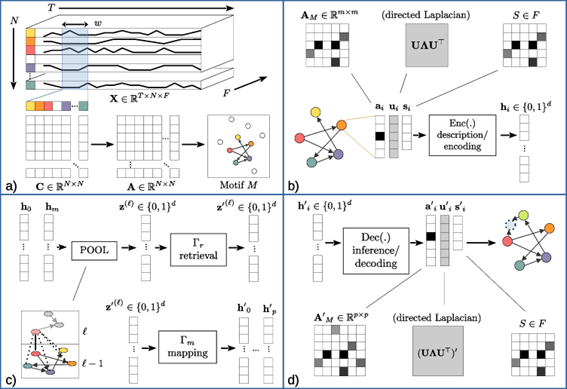
The paper, entitled “A Brain-Inspired Model for Efficient Graph Learning in Human Cyber Physical Networks,” addresses a key challenge in modern industrial environments: the effective integration of human reasoning into cyber-physical systems (CPS).
Despite the growing influence of Artificial Intelligence across industries, experts operating in industrial settings still face significant limitations when interacting with AI-driven systems. Traditional approaches, such as Graph Neural Networks (GNNs), either rely on predefined structures or require large amounts of labeled data, which restricts their adaptability and scalability in real-world scenarios.
To overcome these limitations, the paper introduces the Laplacian Associative-Projective Neural Network (LAPNN), a brain-inspired vector-symbolic architecture capable of learning spatio-temporal structural motifs in human cyber-physical networks. This approach enables a more natural integration of human-like reasoning into machine learning processes, reducing dependency on large datasets while improving interpretability and adaptability.
From the perspective of the DIGEST project, this contribution is highly relevant, as it reinforces the transition towards Industry 5.0 paradigm, where human expertise, cognitive capabilities, and intelligent systems must coexist and cooperate seamlessly.
In particular:
- WP1 (Foundations and Conceptual Frameworks) benefits from the theoretical advances in modeling human–machine interaction within CPS.
- WP2 (Data, Models, and Intelligent Architectures) is strengthened through the introduction of novel AI paradigms that support human-in-the-loop learning and hybrid intelligence.
DIGEST welcomes this contribution as a significant step forward in bridging the gap between human cognition and advanced AI systems, paving the way for more resilient, adaptive, and human-centric industrial ecosystems.