

The need for better IMUs: Is quantum technology the right way?
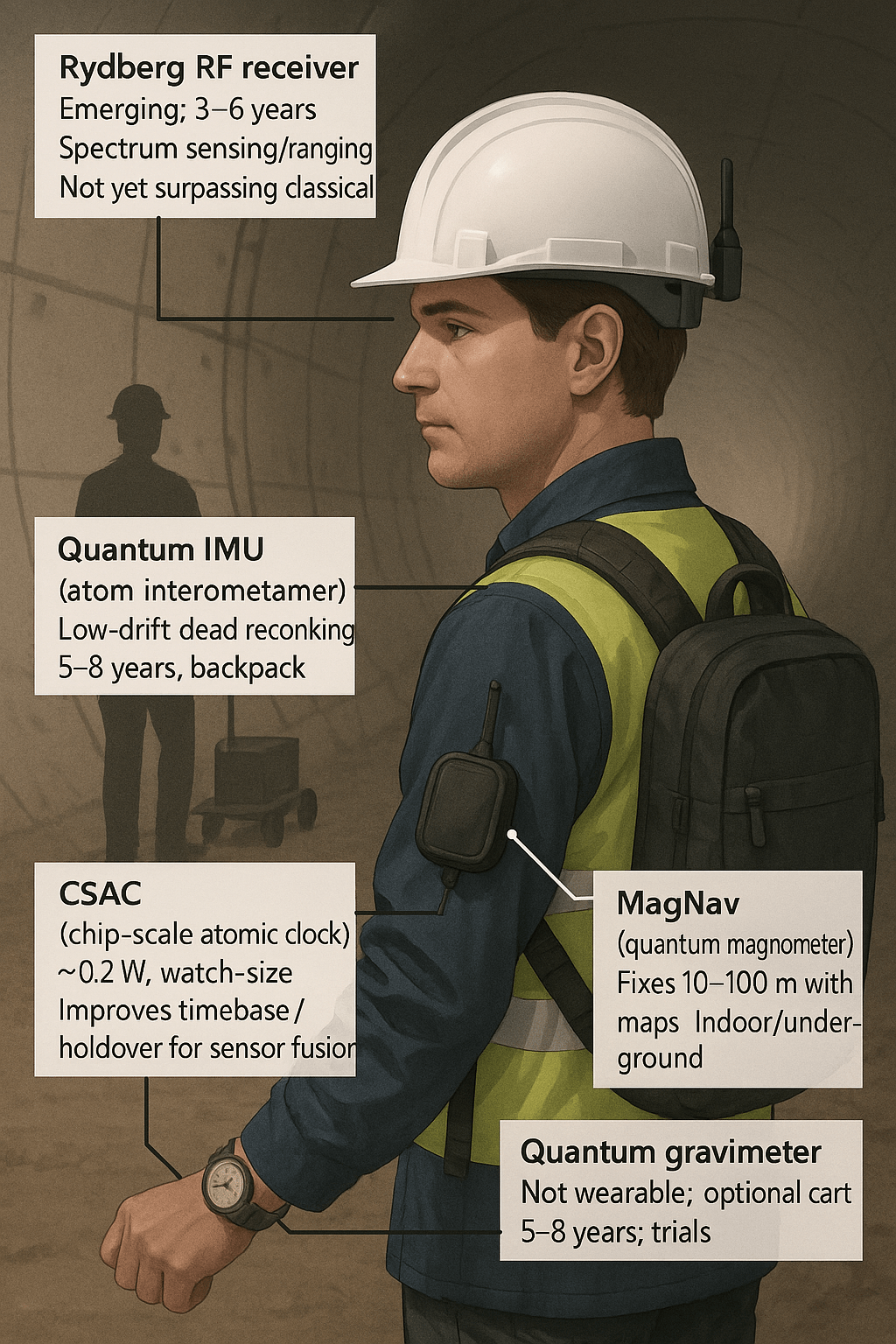
In many wearable and embedded systems, classical Inertial Measurement Units (IMUs) suffer from significant drift over time, while GPS often lacks sufficient accuracy and sampling frequency. This creates a need for new technologies that can deliver more reliable positioning, navigation, and timing (PNT) in challenging or GPS-denied environments.
The Promise of Quantum Sensing in PNT
Quantum technologies are emerging as candidates to enhance—and in some domains, potentially surpass—conventional GNSS-based systems. These advances are particularly promising for timing and navigation robustness, though they have not yet outperformed high-precision global systems like RTK GNSS in terms of absolute positioning accuracy.
- Timing: Quantum clocks—particularly optical clocks combined with fiber-based time transfer—are already outperforming GPS time distribution by orders of magnitude. Onboard high-precision clocks also significantly improve local navigation holdover when GPS signals are unavailable [1].
- Navigation: Quantum IMUs based on atom interferometry provide low-drift inertial navigation, maintaining accuracy for longer durations when GPS is jammed, blocked, or unavailable. While these do not provide absolute coordinates, they are a major step forward in navigation robustness [2].
- Positioning: Quantum-based gravimetry (GravNav) and magnetometry (MagNav) enable map-matching for position estimation without satellites. These approaches are especially valuable in GPS-denied environments such as underground facilities, underwater operations, and contested airspace. However, current positioning accuracy is around 10–100 meters, still far from the centimeter-level precision offered by RTK GNSS. Ongoing research and improved sensors/maps are expected to narrow this gap [3].
- RF and Photonic Quantum Sensors: Quantum sensing is also being explored in radio-frequency (RF) and photonic domains. Rydberg atom-based RF sensors act as quantum antennas or even mixers in vapor cells. While promising for spectrum sensing and possibly passive ranging, classical RF systems still outperform them in sensitivity today [4].
- Quantum LiDAR (Nonclassical Light for Target Ranging): Efforts are underway to use nonclassical light—such as squeezed or entangled photons—for quantum-enhanced LiDAR. This could offer advantages in low-SNR or low-light conditions, but current technology readiness levels (TRLs) remain low [5].
So, Can Quantum Beat GPS?
In short: Yes, but not yet. Quantum technologies show clear advantages in timing, promising progress in navigation robustness, and emerging potential for satellite-free positioning. However, replacing or even fully matching the capabilities of modern GPS systems will require:
- Further technical developments.
- Higher system maturity.
- Considerable integration efforts.
A realistic timeline for broad deployment in real-world applications is approximately 10 years.
References
[1] Huang, Z., Titov, O., Schmidt, M. K., Pope, B., Brennen, G. K., Oi, D., & Kok, P. (2025). Quantum-enabled optical large-baseline interferometry: applications, protocols and feasibility. arXiv preprint arXiv:2505.04765.
[2] Pant, A., Kotiyal, A., & Bansal, M. (2025, May). Quantum Revolution: Integrating Nanotechnology and Artificial Intelligence. In 2025 International Conference on Networks and Cryptology (NETCRYPT) (pp. 1389-1394). IEEE.
[3] Muradoglu, M., Johnsson, M. T., Wilson, N. M., Cohen, Y., Shin, D., Navickas, T., … & Biercuk, M. J. (2025). Quantum-assured magnetic navigation achieves positioning accuracy better than a strategic-grade INS in airborne and ground-based field trials. arXiv preprint arXiv:2504.08167.
[4] Amarloo, H., Noaman, M., Yu, S. P., Booth, D., Mirzaee, S., Pandiyan, R., … & Shaffer, J. P. (2025). A photonic crystal receiver for Rydberg atom-based sensing. Communications Engineering, 4(1), 70.
[5] Ortolano, G., & Ruo-Berchera, I. (2025). Quantum target ranging for LiDAR. Physical Review Research, 7(2), L022059.