

Advancing Self-Guided Industrial Intelligence with Prescriptive Maintenance
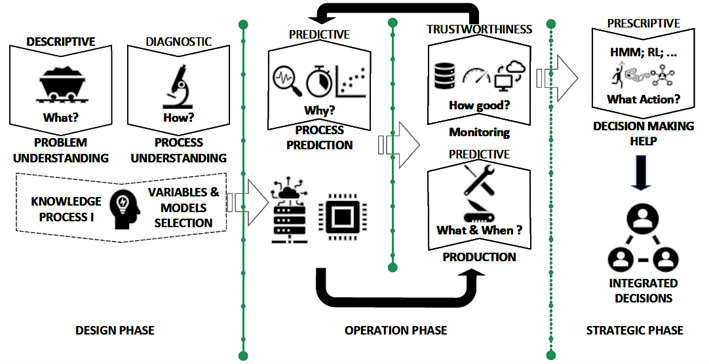
A new scientific contribution connected to DIGEST project, recently published in Applied Sciences, presents a significant step forward in the pursuit of intelligent, autonomous maintenance systems for industry. The article, titled “A Data-Driven Monitoring System for a Prescriptive Maintenance Approach: Supporting Reinforcement Learning Strategies”, explores how self-managed machine learning infrastructures can support long-term predictive accuracy and smarter decision-making in industrial environments.
In this work, the research team addresses a central challenge in digital maintenance: how to ensure that predictive models remain reliable over time as industrial systems evolve. Traditional approaches often deploy machine learning models without considering their performance degradation, leading to diminished trust and limited adoption. In contrast, the proposed framework embraces the full lifecycle of model governance, incorporating continuous performance monitoring, automated retraining, and seamless redeployment.
Crucially, the study demonstrates how this self-supervised infrastructure can empower prescriptive maintenance strategies using reinforcement learning. By incorporating real-time feedback from operational data collected from sensors on electric pump systems in a petrochemical facility, the system not only predicts future states but also helps recommend optimal interventions. The ability to adapt to changing operating conditions while preserving model trustworthiness is a core element of the DIGEST project’s ambition to integrate intelligence into industrial control and decision-making processes.
This research exemplifies DIGEST’s commitment to transforming industrial monitoring into a more sustainable, explainable, and autonomous activity. It bridges the gap between data science and operational technology, laying the groundwork for integrating cloud-native analytics, edge computing, and cyber-physical systems into smart industry workflows. The proposed framework is already compatible with common Industry 4.0 technologies and positions itself as a foundation for future digital twins and agent-based industrial systems.
The full article is openly available through MDPI. It reflects not only a rigorous scientific effort but also a practical pathway toward the real-world deployment of AI-driven maintenance within DIGEST’s living labs.