

From quantum-inspired learning to digital asset intelligence
A new paper recently accepted in Scientific Reports introduces a concept that could reshape how we design intelligent systems at the intersection of AI, sensing, and emerging quantum technologies.
In “Standardized quantum transistor block enables differentiable learning on gait dynamics,” researchers Javier Villalba-Díez and Joaquín Ordieres-Meré present the Quantum Transistor (QT): a standardized, interpretable building block for hybrid quantum–classical machine learning. Rather than focusing on quantum advantage per se, the work addresses a more foundational problem: how to create reusable, analyzable primitives for quantum-enhanced AI, in much the same way classical transistors enabled scalable electronic systems.
The core idea is deceptively simple. The Quantum Transistor acts as a bounded nonlinear processing unit with a clearly defined input–output contract, controllable “gain,” and saturation behavior. These properties mirror those of classical electronic transistors but are implemented using small variational quantum circuits. Crucially, the QT is designed to be differentiable end to end, making it compatible with modern learning pipelines.
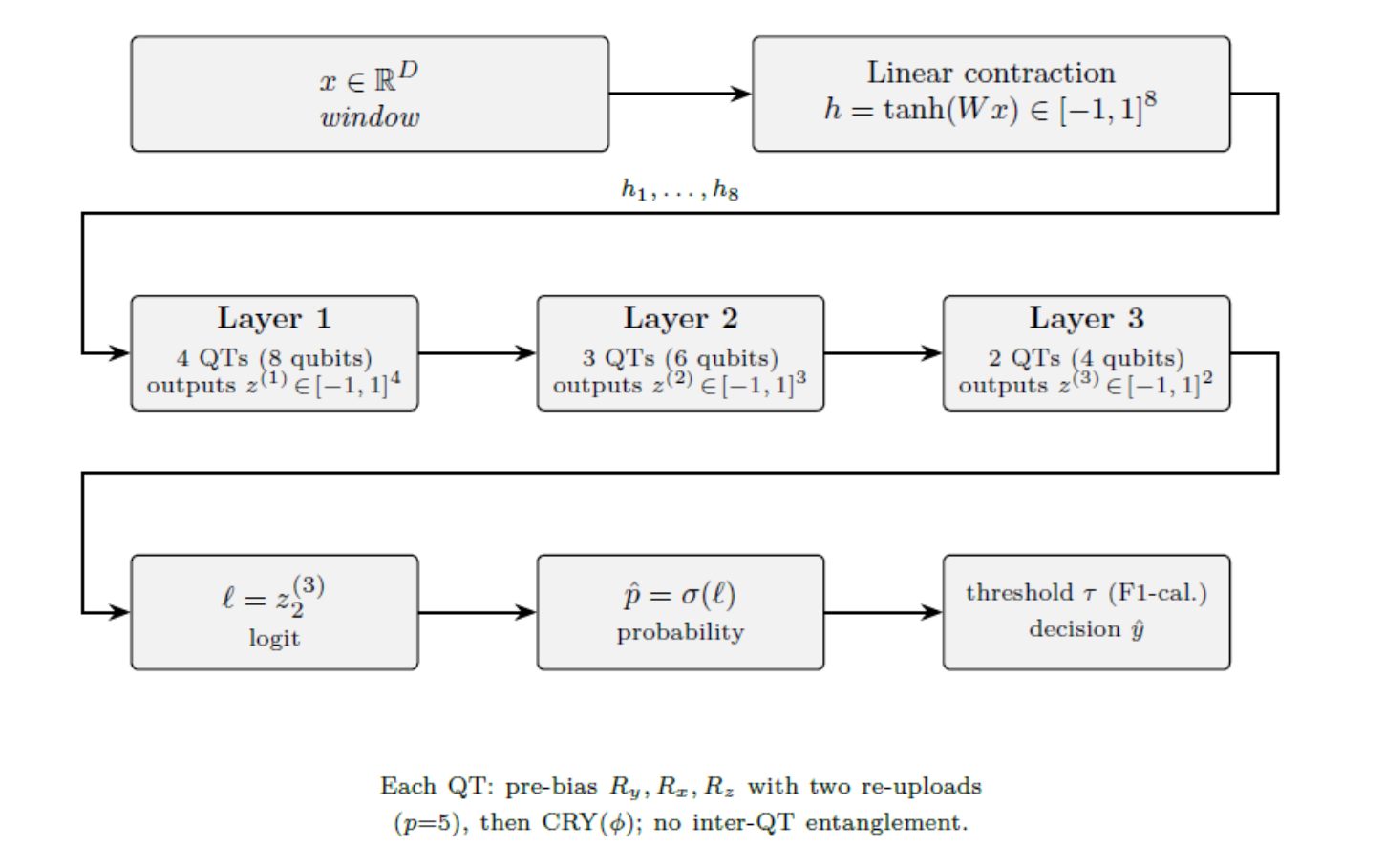
To validate the concept, the authors apply stacked QT blocks to a real-world healthcare problem: subject-aware gait classification in multiple sclerosis patients. Using strict grouped cross-validation, the QT-based network achieves strong performance, approaching that of well-tuned classical deep learning baselines. Importantly, the paper is explicit about not claiming quantum supremacy. Instead, it demonstrates something arguably more important at this stage: that quantum-inspired blocks can be standardized, mathematically characterized, and integrated into practical learning systems with predictable behavior.
Beyond accuracy metrics, the paper highlights several system-level advantages. Because QT has closed-form gain and saturation properties, engineers can reason about signal flow, gradient stability, and noise budgets at the block level. This opens the door to hardware–software co-design, portable compilation across backends, and lightweight conformance testing. In other words, it shifts quantum machine learning away from handcrafted circuits toward an engineering discipline based on reusable components.
It does this matter outside quantum computing because the QT framework embodies a broader paradigm: building intelligent systems from modular, interpretable, and uncertainty-aware primitives. This resonates strongly with ongoing efforts in digitalization, asset intelligence, and decision support—particularly in complex industrial environments.
This is where DIGEST focuses on creating advanced digital frameworks for asset management, combining digital twins, explainable AI, predictive maintenance, and decision support across strategic, operational, and component levels. One of our core challenges is integrating heterogeneous data streams (sensor signals, operational records, human inputs), into coherent, trustworthy models that can guide maintenance, investment, and sustainability decisions.
The Quantum Transistor concept aligns naturally with this vision. Its emphasis on standardized computational blocks, interpretable dynamics, and bounded behavior mirrors DIGEST’s goals of transparency, explainability, and system-level integration. The paper’s hybrid architecture, combining classical preprocessing with quantum-inspired nonlinear modules, offers a concrete example of how future digital twins and asset intelligence platforms might incorporate emerging computing paradigms without sacrificing reliability or interpretability.
Moreover, DIGEST explicitly explores the role of advanced computation, including quantum technologies, in next-generation digital twins. The QT framework provides a practical pathway: rather than waiting for large-scale fault-tolerant quantum computers, organizations can begin adopting quantum-inspired, block-based architectures today, while remaining compatible with future quantum co-processors as they mature.
In this sense, the Scientific Reports paper is not just a contribution to quantum machine learning. It is a step toward a new engineering mindset for intelligent systems, one where modularity, uncertainty awareness, and system-level reasoning take center stage. For initiatives like DIGEST, which aim to connect AI, asset management, and digital transformation, this work offers both conceptual foundations and concrete tools.
As industries move toward Industry 5.0, with stronger emphasis on human-centricity, sustainability, and resilience, such hybrid and interpretable approaches will become increasingly important. The Quantum Transistor is an early but compelling example of how these future systems might be built.