

Agentic AI and federated monitoring: New advances presented at the EsReDA seminar
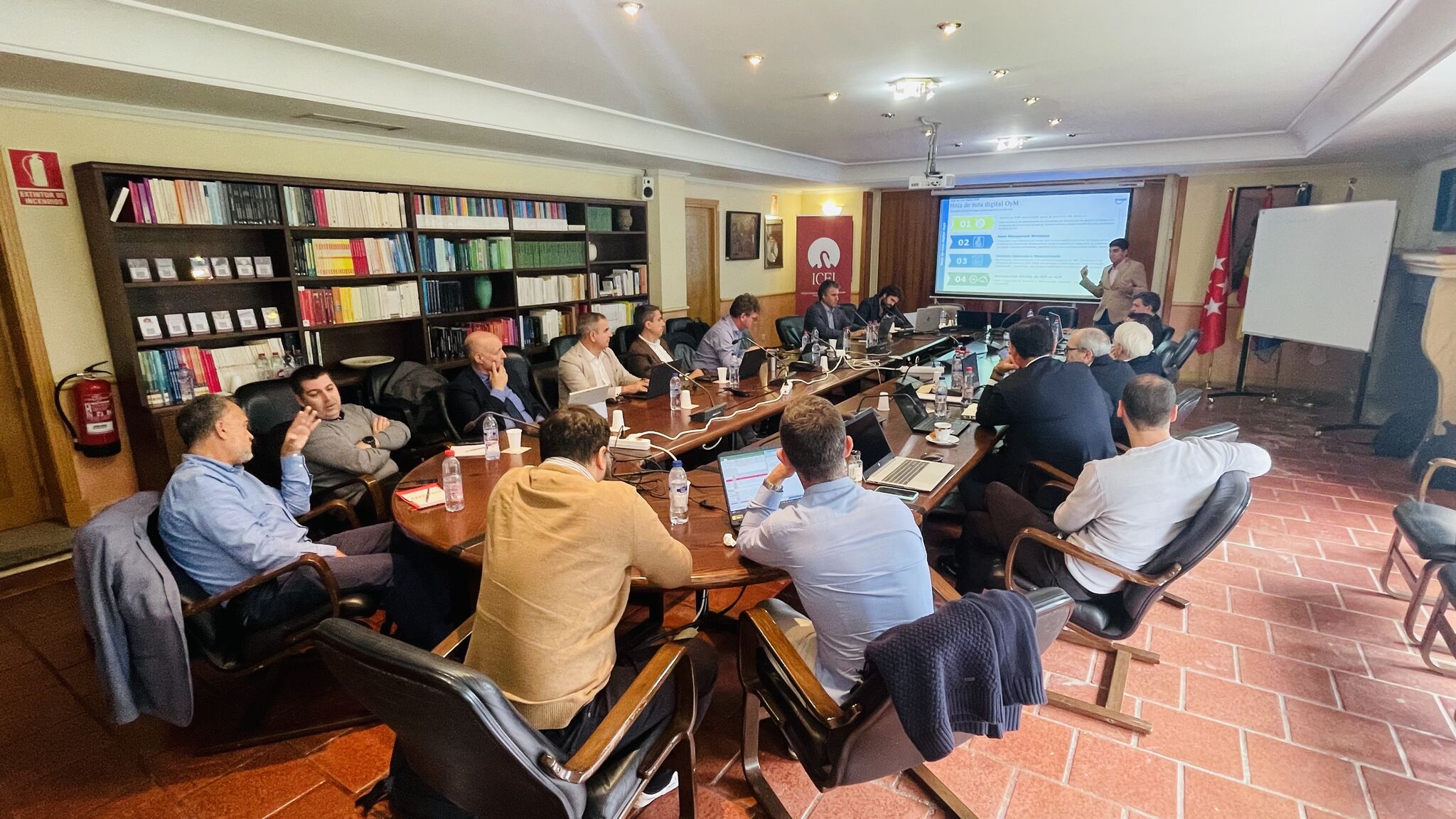
📅 October 21st, 2025
📍 Colegio Complutense, Madrid.
On October 21st, during the EsReDA Seminar held at the Colegio Complutense in Madrid, Professor Joaquín Ordieres presented a forward-looking vision on how agentic AI and advanced semantic integration are reshaping the monitoring and management of industrial assets. The talk, titled “Agentica para Inteligencia Artificial: The Agentic Organization,” highlighted how the technologies being developed within the DIGEST Project are paving the way toward a new generation of autonomous, context-aware decision-support systems.
Traditional approaches to industrial monitoring rely heavily on centralized dashboards and static analytics. However, as Prof. Ordieres emphasized, the emergence of Large Language Models (LLMs) and multipurpose agents introduces a paradigm shift: organizations can now benefit from distributed reasoning workflows capable of interpreting sensor data, querying scientific models, or even orchestrating complex information pipelines in real time.
This approach complements DIGEST’s mission to build a federated knowledge layer for smart buildings and industrial environments—one that integrates BIM, IoT sensor streams, and advanced semantic models to deliver actionable insights with minimal human intervention.
One of the core messages of the presentation was the strategic value of expanding the perspective from simple monitoring toward full lifecycle asset management. With DIGEST’s architecture:
- Multimodal data sources, temperature, occupancy, environmental parameters, maintenance logs, are unified through semantic agents.
- Local and private data remain protected through on-premise LLM deployments and controlled inference workflows.
- Agent-based orchestration allows LLMs to choose the correct tools or domain-specific agents for each task, improving reliability and traceability.
- Graph-based contextualization (DBGRAPH) links real sensor readings with the BIM structure, enabling higher-level reasoning such as anomaly interpretation, risk forecasting, or operational optimization.
For industrial stakeholders, this means more than just seeing data—it means understanding it in context, automatically, and at scale.
During the seminar, a live example illustrated how DIGEST’s agentic architecture decomposes a complex query—estimating heat generation in a laboratory—into multiple reasoning steps: retrieving sensor data, checking weather records, querying scientific publications, cross-validating results, and finally producing an interpretable estimate with confidence scores.
This demonstration shows how federated semantic agents bridge the gap between physical measurements and domain knowledge, offering a direct path toward automated diagnostics and prescriptive maintenance.
Prof. Ordieres’s contribution at EsReDA reinforces DIGEST’s position as a leading initiative in Europe for the integration of semantic modeling, AI-driven reasoning, and industrial asset management. By combining sensor data, contextual knowledge, and agentic AI strategies, DIGEST is not only improving monitoring accuracy but also enabling full-spectrum decision-making, from anomaly detection to predictive insight and strategic planning. The developments shown in Madrid underline a clear message: the future of industrial asset management lies in systems capable of understanding their own data. DIGEST is building precisely that future.
This seminar was held as a technical workshop on the road the CONGREGA26, which will be held from October 14th to 16th, 2026, in Braga, Portugal.